|
Rural
Landscapes of Westport
The
rich, but rock-peppered glacier soil of Westport’s farmlands gave rise to
hundreds of miles of scenic dry stone walls that frame almost every acre of
useable Westport farm and field. Many of these walls still exist today. Our
protected harbor, even with its swift currents and treacherous moon tides,
gave home to our early fishing industry, and later to ship building and
whaling. Lumber for Westport’s whalers came from northern Westport and beyond
via the Acoaxet (Westport) River. The dependable and swift flow of the
Westport River, particularly the East Branch, spawned many saw, grist, and
small tool mills that allowed rapid growth and prosperity to the Head of
Westport. This manufacturing period peaked with the incorporation of the
Westport Factory, a textile manufacturer and a community that operated well
into the 20th century. View 137 high
resolution photos of seashore vistas. Updated as of October 20, 2010. | Dial-Up Speed | Broadband/DSL | Read news story about the
Head of Westport. But
farming remained the chief use of the land, with dairy farms more recently
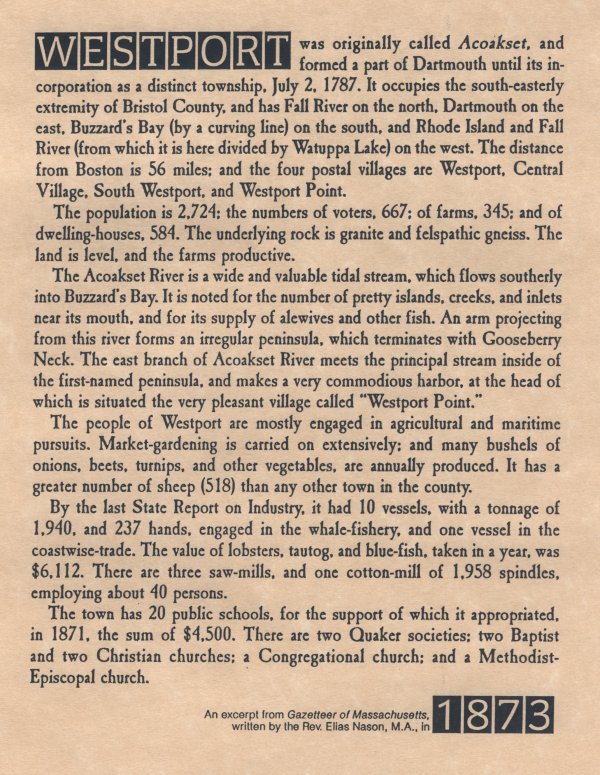
being the most prominent. Read about 1899 Westport to understand its origins.
Today,
one will find that some of our early 20th century farms have been
abandoned and overgrown, and some have been developed into sprawling
residential neighborhoods. However, with the help of community preservation
funds, agricultural preservation restrictions, and land trust protection,
some of Westport’s early character is being preserved, from Old Bedford Road,
to Old Pine Hill Road, to picturesque Old Harbor Road. We owe much to the
organizations listed below. Our tidal rivers are the focal point for a
picturesque community rich with rolling pastures and fields interlaced by
fieldstone and granite walls, and peppered with historic cemeteries. An
interconnected series of millponds, lakes, and reservoirs, once the backbone
of our industrialized Westport, are there still for all to enjoy. This photo
essay illustrates another flavor of rural Westport. Click on each of
the logos below to learn more about Westport preservation efforts.
Copyright © 2004 - 2011 Community Events of Westport.
All
rights reserved. Photographs and text are protected by Federal Copyright.
Reproduction of any kind without written permission is strictly prohibited. |